Technology vs. Loneliness: What Actually Reconnects Older Adults
Loneliness in later life is not a mood problem - it's a health problem. Chronic isolation is associated with sharply elevated risks of heart disease, depression, cognitive decline, and earlier death; public-health bodies now discuss it in the same breath as smoking and obesity.
Loneliness in later life is not a mood problem - it's a health problem. Chronic isolation is associated with sharply elevated risks of heart disease, depression, cognitive decline, and earlier death; public-health bodies now discuss it in the same breath as smoking and obesity. So when we ask whether technology can help lonely older adults, we're really asking a clinical question. The honest answer from research and practice: yes - dramatically - but only certain kinds of technology, used certain ways. The dividing line is whether the technology leads to human relationship or substitutes for it.
Key takeaways
- Interactive, relationship-directed technology (video calls, messaging, interest communities) measurably helps; passive scrolling doesn't.
- Ritual beats hardware: a standing Sunday video call is the intervention, the tablet is just the vehicle.
- Voice assistants are the accessibility ramp that makes all other connection possible for many older adults.
- AI companions are a legitimate supplement and a dangerous substitute - soothe the 3 a.m. hours, never excuse the empty Sundays.
What's the difference between technology that connects and technology that pacifies?
Video calls with grandchildren, a group chat with old friends, an online class with real classmates, a forum of people who share your diagnosis - these are bridges. Passive scrolling, algorithmic video feeds, and parasocial content - the same engagement traps that hook teenagers - are pacifiers: they fill hours while leaving the loneliness untouched or worse. Research on social media use in older adults splits along exactly this line: *active, interactive* use correlates with wellbeing; *passive consumption* correlates with the opposite. The question to ask of any app: does it end in a person?
Which technologies have the strongest track record?
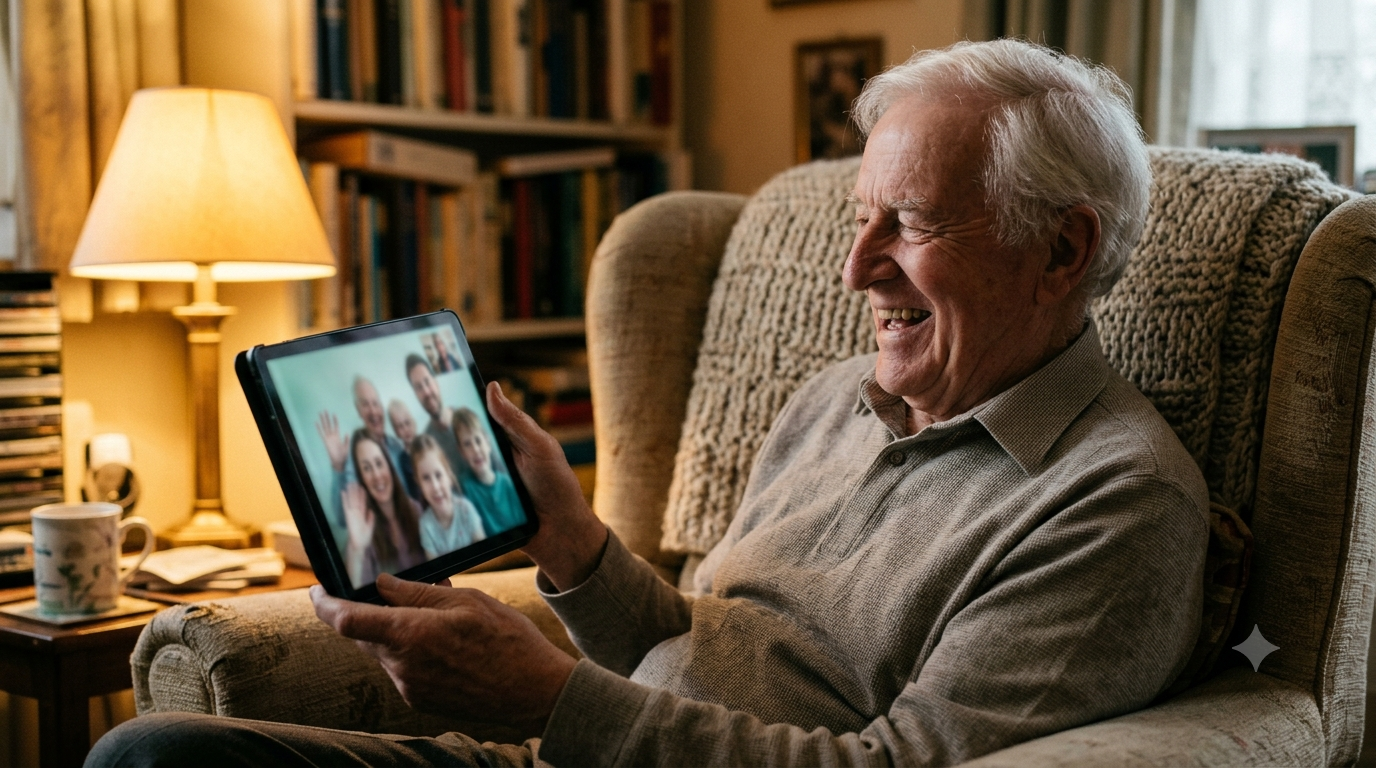
- Video calling, ritualized. Not "call whenever" - a standing slot. Sunday dinner on the tablet, Wednesday breakfast with the grandkids. Ritual converts technology into relationship.
- Messaging and photo streams. Low-pressure ambient connection: a shared family album that fills with ordinary moments beats a monthly performance call. Voice messages work beautifully for arthritic hands and expressive hearts.
- Interest communities. Online chess, book clubs, faith services, veteran groups, birding forums - communities organized around *identity and interest*, where age is incidental. Purpose-driven connection outperforms connection-for-connection's-sake.
- Learning platforms. A live online class delivers the trifecta: cognitive challenge, social contact, and a reason to show up next week.
- Voice assistants as social ramps. "Call Susan" removes every barrier between impulse and contact - no glasses, no menus, no dialing. For people with vision, dexterity, or memory challenges, voice is the accessibility layer that makes all other connection possible.
Can AI companions and robots fill the gap?
Partially, and the nuance matters. Studies of robotic pets and conversational companions show real reductions in agitation and self-reported loneliness for some users, particularly in dementia care - comfort is comfort, and we don't dismiss it (we explored this in AI in dementia care). But a companion that talks back is not a relationship that knows your history and shows up at the hospital. Our position, as clinician and technologist: AI companionship is a legitimate supplement and a dangerous substitute. Deploy it to soothe the 3 a.m. hours, never to excuse the empty Sunday ones.
What actually makes adoption stick?
The failure mode is predictable: family gifts a tablet at Christmas, sets it up in an afternoon, leaves; the tablet becomes a coaster by February. What works instead: one device, one purpose, one ritual to start (this tablet is how we do Sunday dinner); a patient human teacher - grandchildren are famously effective, and the teaching itself is connection; accessibility settings dialed in on day one (text size, volume, captions); and expansion only after the first ritual is beloved. Technology adoption in later life is a relationship process wearing a technical costume.
The bottom line
Technology is an amplifier. Pointed at relationships - rituals, communities, purpose - it collapses distance and can genuinely restore connection to housebound, far-flung, and bereaved lives. Pointed at passive consumption, it decorates isolation. The device matters far less than the direction.
Frequently asked questions
Does technology actually reduce loneliness in older adults? Yes, when it's interactive and relationship-directed - video calls, messaging, interest communities show measurable benefits. Passive consumption (scrolling, watching) shows neutral to negative effects.
What's the single best technology for a lonely parent? A tablet or smart display with one standing video-call ritual attached to it. The ritual, more than the device, is the intervention.
Are AI companion apps healthy for isolated seniors? As a supplement - comfort between human contacts - evidence is cautiously positive, especially in dementia care. As a replacement for human relationships, they risk masking a problem that continues to harm health.
How do I help a parent who says they're "too old" for technology? Lead with the person, not the device: "This is how you'll see the grandkids every Sunday." Start with one purpose, teach patiently in person, and let the first success recruit them to the second.
*Brain Meets Bytes - Science First. Human Always. Join the community - and share this with someone who checks in on a parent from far away.*
This article is for general education and is not medical advice.